Pay Your Bill:

Most parents assume Invisalign is just a cosmetic upgrade over braces — something for adults who want a cleaner look. But there’s a lot more happening with clear aligner treatment in teenagers than people realize, and some of it genuinely changes how orthodontic care works at this age.
The Teen Mouth Is Still Changing — and That Matters
Teenagers are in an active growth phase. Teeth shift, jawbones develop, and second molars are often still coming in. Traditional metal braces were designed around this reality — fixed brackets don’t rely on patient cooperation.
Invisalign for teens, however, has been updated specifically for this stage of development. Here’s what’s different compared to adult Invisalign:
- Eruption tabs — built-in spaces that accommodate incoming molars without redoing the treatment plan
- Blue compliance indicators — small dots on each aligner that fade with wear, so parents can check without confrontation
- Replacement aligners — most teen plans include several free replacements for lost or damaged trays
Why Teenagers in Franklin and Smyrna Are Choosing Clear Aligners
For teenagers growing up in communities like Franklin and Smyrna — where school photos, sports, and social life are a big deal — the practical side of clear aligners matters.
Metal braces come with food restrictions (no popcorn, hard candy, sticky snacks), and they require extra care during brushing and flossing. For a busy teenager juggling school, extracurriculars, and everything else, that routine adds friction.
Clear aligners remove differently. Teens eat whatever they want, brush normally, and the trays go back in. For families in the Franklin area looking into Invisalign in Franklin, this flexibility is often the deciding factor.
The experience is also quieter in a social sense. Most classmates won’t notice the aligners at all.
What Treatment Actually Looks Like
Here’s a realistic picture of what a teenager goes through with Invisalign:
- Initial consultation — digital scans or impressions to map the teeth
- Custom aligner set — a series of trays, each worn for about 1–2 weeks
- Check-ins every 6–10 weeks — to monitor progress and hand off new trays
- Total treatment time — typically 12 to 18 months for most teen cases, though complexity varies
Attachments — small tooth-colored dots bonded to certain teeth — are sometimes used to help aligners grip and guide more stubborn movements. Not every case needs them, but they’re worth knowing about, so teens aren’t surprised.
Does Compliance Actually Work Out?
This is the most honest question to ask. Invisalign requires 20–22 hours of wear per day. For adults, that’s usually fine. For teenagers, it depends on the individual.
Research has shown that compliance among teens is comparable to that of adults when parents are informed and involved early. The blue wear indicators help with accountability without making it feel like surveillance.
Some teenagers actually prefer this format — they feel more in control of their treatment compared to fixed appliances they can’t remove.
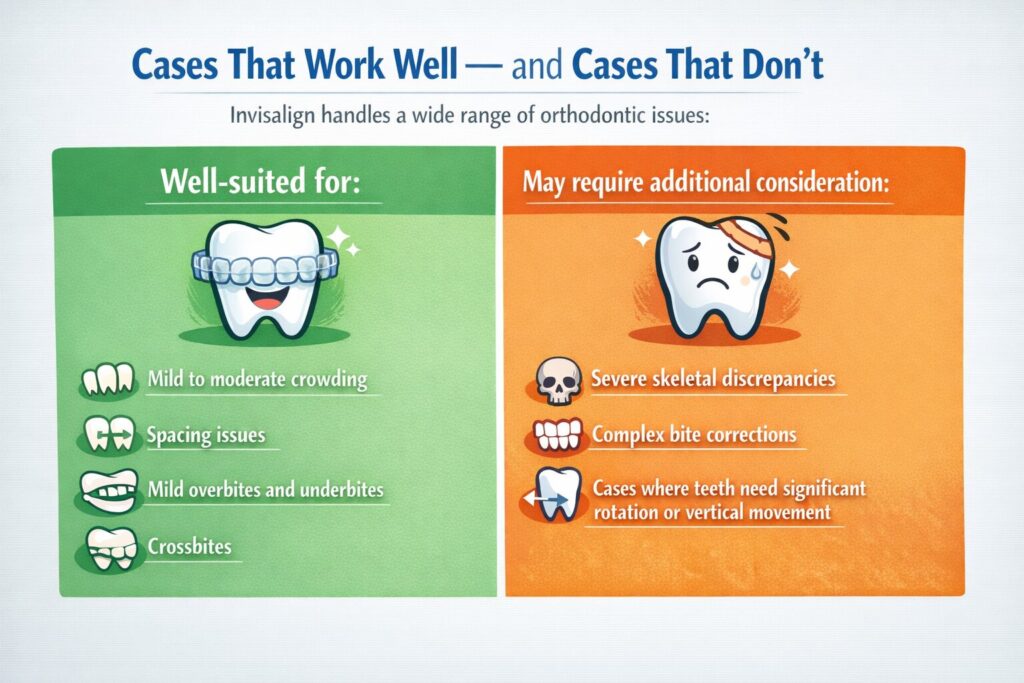
Cases That Work Well — and Cases That Don’t
Invisalign handles a wide range of orthodontic issues:
Well-suited for:
- Mild to moderate crowding
- Spacing issues
- Mild overbites and underbites
- Crossbites
May require additional consideration:
- Severe skeletal discrepancies
- Complex bite corrections
- Cases where teeth need significant rotation or vertical movement
An orthodontist’s evaluation determines candidacy. Not every teenager is an ideal Invisalign candidate, and a good provider will be upfront about that. Families considering Invisalign in Smyrna should ask specifically whether clear aligners are appropriate for their child’s clinical situation, not just their preference.
The Retainer Phase Gets Overlooked
Most of the conversation focuses on active treatment — the aligners. But what happens after matters just as much.
Once teeth reach their final position, retainers are required. For Invisalign patients, this is often a clear retainer worn nightly. Teens who skip this step risk their teeth drifting back, which isn’t unique to Invisalign — it applies to braces, too.
Parents should factor retainer compliance into the overall conversation, especially because orthodontic relapse is one of the more common reasons adults end up re-correcting issues corrected in their teens.
Is the Cost Different From Braces?
Whether you are interested in traditional braces or Invisalign for your teen, the costs are similar; pricing may depend on where you live and the complexity of their case.
Many dental insurance companies offer the same benefits for clear aligners as they do for traditional metal braces, and financing or payment plans are also available through most orthodontists. It’s always best to talk with your orthodontist directly for an estimate based on your individual case.
Taking the Next Step Toward a Straighter Path
If your teen has been delaying orthodontic treatment or if you are unsure whether choosing Invisalign for your teen is worth it, a consultation with an orthodontist is the best way to move from a general discussion to a specific treatment plan for your child’s teeth.
Happy Harpeth Pediatric Dentistry & Orthodontics serves families in Franklin and Smyrna, with two convenient locations and a team that specializes in children and teens.
Schedule a consultation online or by phone. Same-family appointments are available.
Common Questions People Ask
At what age can a teenager start Invisalign?
Most orthodontists recommend waiting until most permanent teeth have come in, typically around ages 12–13. The exact timing depends on each patient’s dental development.
How is Invisalign Teen different from regular Invisalign?
Invisalign Teen includes eruption tabs for incoming molars, compliance indicators, and replacement aligners — features not included in standard adult plans.
What happens if my teen loses an aligner?
Teen plans typically include a set number of free replacement aligners for exactly this reason. Contact your orthodontist promptly to avoid interrupting treatment.
Can my teenager play sports with Invisalign?
Yes. Aligners can be removed for contact sports, and a mouthguard can be worn instead. This is actually an advantage over metal braces, which can cause soft tissue injuries during impact.